
Introduction
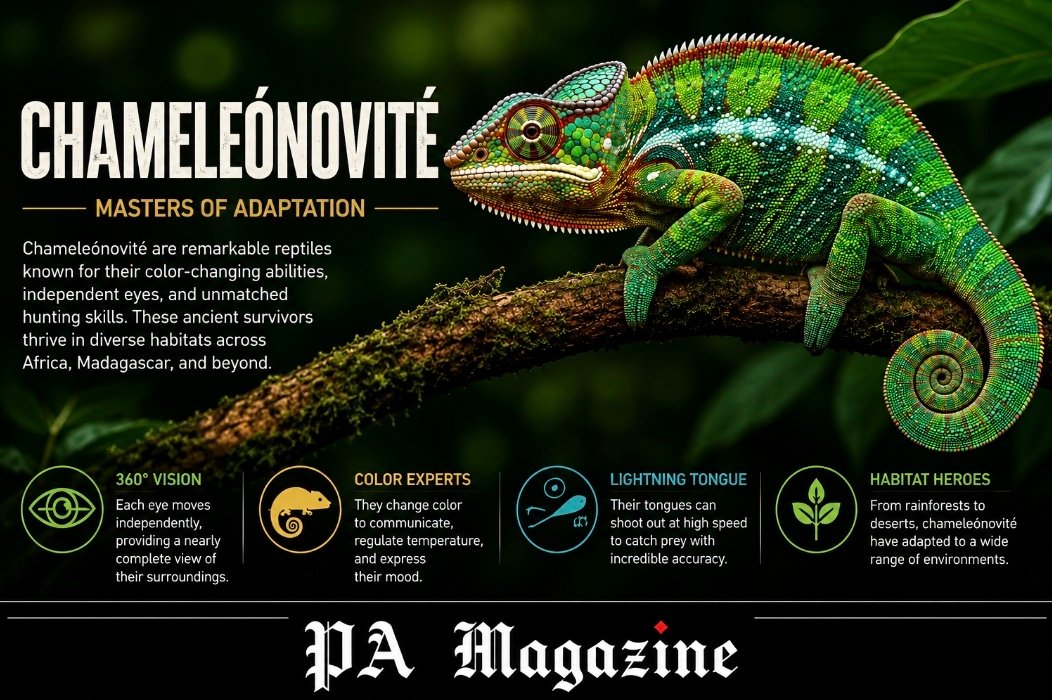
The natural world is filled with extraordinary creatures, but few animals capture human curiosity quite like the chameleons known scientifically as chameleónovité. These reptiles are famous for their color-changing abilities, unusual eyes, and slow, deliberate movements that make them appear almost unreal. For centuries, people have associated chameleónovité with mystery, transformation, and adaptation. Yet behind their striking appearance lies a complex group of animals with remarkable biological features that scientists are still studying today.
Chameleónovité are not simply lizards that change colors for entertainment or disguise. Their behavior is tied deeply to communication, body temperature regulation, mood, and survival. From the rainforests of Madagascar to dry African woodlands, these reptiles have evolved into highly specialized hunters capable of thriving in difficult environments. Their ability to blend into surroundings is only one small part of what makes them exceptional.
Interest in chameleónovité has increased worldwide because of wildlife documentaries, exotic pet culture, and scientific research focused on reptile evolution. However, many species now face serious threats due to habitat destruction, illegal wildlife trade, and climate change. Understanding these animals in greater depth reveals not only their beauty but also the fragile ecosystems they depend on.
What Is Chameleónovité
The term chameleónovité refers to the biological family Chamaeleonidae, a group of reptiles commonly known as chameleons. This family contains more than 200 recognized species distributed mainly across Africa, Madagascar, southern Europe, parts of the Middle East, and sections of Asia. Madagascar alone hosts a massive percentage of the world’s known chameleon species, many of which exist nowhere else on Earth.
READ MORE’ obstetrika and the Changing Science of Safe Childbirth
Chameleónovité belong to the reptile order Squamata, which also includes snakes and other lizards. What separates them from most reptiles is their highly specialized anatomy. Their independently moving eyes provide nearly 360-degree vision, while their projectile tongues allow them to catch insects at astonishing speed. Many species also possess prehensile tails that function like an additional limb when climbing branches.
These reptiles range dramatically in size. The tiny Brookesia nana, discovered in Madagascar, measures less than an inch long, while larger species such as the Parson’s chameleon can exceed two feet in length. Despite these differences, members of chameleónovité share similar evolutionary adaptations designed for life in trees and dense vegetation.
The Extraordinary Evolution of Chameleónovité
Scientists believe the ancestors of chameleónovité evolved millions of years ago, gradually developing traits suited for arboreal life. Fossil evidence suggests early chameleon relatives may have existed during the Paleogene period, although modern species diversified much later.
One of the most fascinating aspects of chameleónovité evolution is how isolated environments shaped unique species. Madagascar became a major center of diversification because geographic separation allowed species to evolve independently over long periods. This explains why the island contains such unusual varieties with distinct horns, crests, and body structures.
Evolution also favored stealth and patience over speed. Unlike many predators that chase prey aggressively, chameleónovité developed a hunting strategy based on stillness and precision. Their swaying movements imitate leaves shifting in the wind, reducing the chance of detection by insects or predators.
Over time, their skeletal structure adapted for climbing. Their feet split into opposing groups of toes, functioning almost like pincers that grip branches securely. Combined with strong tails and flexible limbs, these features transformed chameleónovité into highly effective tree-dwelling reptiles.
Why Chameleónovité Change Color
The idea that chameleons change color purely for camouflage is one of the most widespread misconceptions in zoology. While camouflage does play a role, the reality is far more complex.
The skin of chameleónovité contains specialized cells called chromatophores and iridophores. These cells manipulate pigments and reflect light differently depending on environmental and emotional conditions. Stress, fear, aggression, courtship, temperature changes, and communication all influence color variation.
Male chameleónovité often display brighter colors during territorial disputes or mating rituals. Intense reds, yellows, and blues can signal dominance or reproductive readiness. Darker tones may indicate illness, fear, or attempts to absorb heat in cooler weather.
Recent scientific research has shown that some species alter microscopic crystal structures beneath their skin to reflect different wavelengths of light. This mechanism produces rapid and dramatic shifts in appearance. Such discoveries demonstrate that chameleónovité possess one of the most advanced color-display systems found in reptiles.
Vision and Hunting Abilities
The visual system of chameleónovité is among the most sophisticated in the reptile world. Each eye moves independently, allowing the animal to observe two separate areas simultaneously. This gives the reptile an enormous field of vision without moving its head.
When prey is detected, both eyes focus forward to judge depth accurately. This transition from panoramic scanning to precise targeting happens within seconds. The tongue then launches outward with incredible acceleration, often reaching prey faster than the human eye can track.
The tongue of some chameleónovité species extends more than twice the length of their body. Elastic tissues store energy before release, creating explosive speed. The sticky tongue tip grips insects instantly, pulling them back into the mouth with remarkable efficiency.
This hunting method conserves energy. Instead of pursuing prey actively, chameleónovité rely on patience and precision. Such efficiency is especially valuable in habitats where food availability fluctuates seasonally.
The Diverse Habitats of Chameleónovité
Chameleónovité inhabit an impressive variety of ecosystems. Tropical rainforests provide dense vegetation and humidity ideal for many species, while others thrive in dry savannas, mountain forests, or semi-desert regions.
Madagascar remains the global center of chameleon diversity. The island’s isolated landscapes allowed species to adapt to highly specific ecological niches. Some inhabit rainforest canopies, while others remain close to the forest floor among dead leaves and moss.
African mainland species display equally fascinating adaptations. Certain desert-dwelling chameleónovité survive harsh heat by altering body color to regulate temperature and minimize water loss. Mountain species, meanwhile, endure cooler climates at higher elevations.
Habitat specialization makes these reptiles highly vulnerable to environmental changes. Deforestation and agricultural expansion destroy vegetation structures necessary for climbing, nesting, and hunting. Because many species occupy limited geographic ranges, even small habitat disturbances can threaten entire populations.
Reproduction and Life Cycle
The reproductive behavior of chameleónovité varies significantly among species. Most lay eggs, although some give birth to live young. Courtship often involves elaborate color displays and body movements designed to attract mates or intimidate rivals.
Female egg-laying species dig nests in soil where eggs remain buried for months. Incubation periods differ widely depending on temperature, humidity, and species characteristics. Some eggs hatch within a few months, while others require nearly a year.
Newly hatched chameleónovité are fully independent from birth. They instinctively climb vegetation and begin hunting tiny insects immediately. Survival rates in the wild are low because juveniles face numerous predators including birds, snakes, and larger reptiles.
Life expectancy also differs dramatically. Smaller species may survive only two or three years, whereas larger chameleónovité can live beyond a decade under favorable conditions. In captivity, proper environmental management significantly influences longevity.
Chameleónovité in Human Culture and Science
Throughout history, chameleons have symbolized transformation, patience, adaptability, and illusion. Ancient cultures often viewed them as mysterious creatures because of their unusual appearance and color-changing abilities. In some regions, folklore portrayed them as magical animals capable of influencing weather or fortune.
Modern science sees chameleónovité as valuable subjects for evolutionary biology and biomechanics research. Their visual systems, tongue mechanics, and skin structures inspire technological innovation in robotics, optics, and material science.
Researchers studying chameleónovité have gained insights into how biological nanostructures manipulate light. Such findings may eventually influence the development of advanced materials with adjustable color properties.
At the same time, these reptiles have become increasingly popular in the exotic pet trade. Species like the veiled chameleon and panther chameleon are commonly kept by reptile enthusiasts. However, improper care frequently leads to health problems because chameleónovité require precise humidity, lighting, and dietary conditions.
Threats Facing Chameleónovité Today
Despite their evolutionary success, many chameleónovité species now face uncertain futures. Habitat destruction remains the largest threat. Forest clearing for agriculture, logging, mining, and urban expansion continues to eliminate critical ecosystems across Africa and Madagascar.
Climate change presents additional challenges. Temperature shifts and altered rainfall patterns affect breeding cycles, vegetation growth, and insect populations that chameleónovité rely upon for food. Species with narrow habitat ranges are particularly vulnerable because they cannot easily relocate.
Illegal wildlife trade also contributes heavily to population decline. Rare and colorful species are often captured for international pet markets. Even when collection is technically regulated, smuggling remains difficult to control.
Conservation organizations increasingly emphasize habitat protection and captive breeding programs. Scientists are also conducting field surveys to identify species before they disappear. Several chameleónovité species have already become critically endangered due to rapid environmental change.
The Ecological Importance of Chameleónovité
Chameleónovité play an important role within their ecosystems. As insect predators, they help regulate populations of flies, grasshoppers, moths, and other invertebrates. This natural control contributes to ecological balance within forests and grasslands.
At the same time, chameleons serve as prey for birds, snakes, and mammals. Their position within food webs connects multiple layers of biodiversity. Removing them from ecosystems can disrupt predator-prey relationships in ways that scientists do not fully understand.
Because many chameleónovité species are highly sensitive to environmental disturbances, they also function as biological indicators. Declining populations may signal broader ecological problems such as pollution, habitat fragmentation, or climate instability.
Protecting these reptiles therefore benefits entire ecosystems rather than individual species alone.
READ MORE: ordenari and the Rise of Ingredient-Led Skincare
Conclusion
The world of chameleónovité is far more complex than the popular image of a color-changing lizard sitting quietly on a branch. These reptiles represent millions of years of evolutionary specialization, resulting in extraordinary vision, hunting precision, and adaptive behavior. Their ability to survive in diverse habitats reflects a delicate balance between biology and environment.
Yet the future of many chameleónovité species is increasingly uncertain. Human-driven habitat destruction, illegal trade, and climate change threaten some of the most unique reptiles on Earth. Greater awareness and conservation efforts are essential if future generations are to witness these remarkable creatures in the wild.
Studying chameleónovité also reminds us how much nature still has to teach humanity. From advanced color-changing skin structures to unmatched visual coordination, these reptiles continue to inspire scientific curiosity across multiple fields. They are not simply animals of camouflage; they are living examples of adaptation, resilience, and ecological complexity.
FAQs
What does chameleónovité mean?
Chameleónovité refers to the biological family of reptiles known as chameleons. It includes more than 200 species found mainly in Africa and Madagascar.
Why do chameleónovité change color?
Chameleónovité change color for communication, temperature regulation, emotional expression, and camouflage. The process involves specialized skin cells that manipulate light and pigment.
Where are most chameleónovité species found?
Most species live in Madagascar and mainland Africa, although some are also found in southern Europe, the Middle East, and parts of Asia.
Are chameleónovité dangerous to humans?
No, chameleónovité are generally harmless to humans. They are shy reptiles that primarily feed on insects and prefer avoiding confrontation.
Why are many chameleónovité species endangered?
Habitat destruction, climate change, and illegal wildlife trade are the main reasons many chameleónovité species face population decline and increasing extinction risk.
READ MORE: https://pamagazine.co.uk/